
· Tutorial
Ball Thrust 3D: from Rapier to a trainable DQN
Real physics, 21 observations, a DQN that learns and verifiable inference after a local checkpoint reload.
Release the right arrow: the sphere keeps rolling. Push toward an obstacle: it gets blocked or bounces. In Ball Thrust, these reactions come from the Rapier physics world, not an animation selected by the network.
The demo now connects manual play, a real TrainingEnv, a trainable TensorFlow.js DQN and inference on that same network. You can pause training, keep the weights in your browser, reload the page and observe the policy without further updates. This demonstrates actual learning updates, not automatic convergence.
Play, train and test Ball Thrust 3D →
A network controlling real physics
A cyan 1 kg sphere moves inside a 12 × 12 m arena with four walls and three fixed obstacles. All have real colliders. Only the sphere is dynamic; impulses, gravity and contacts determine its movement.
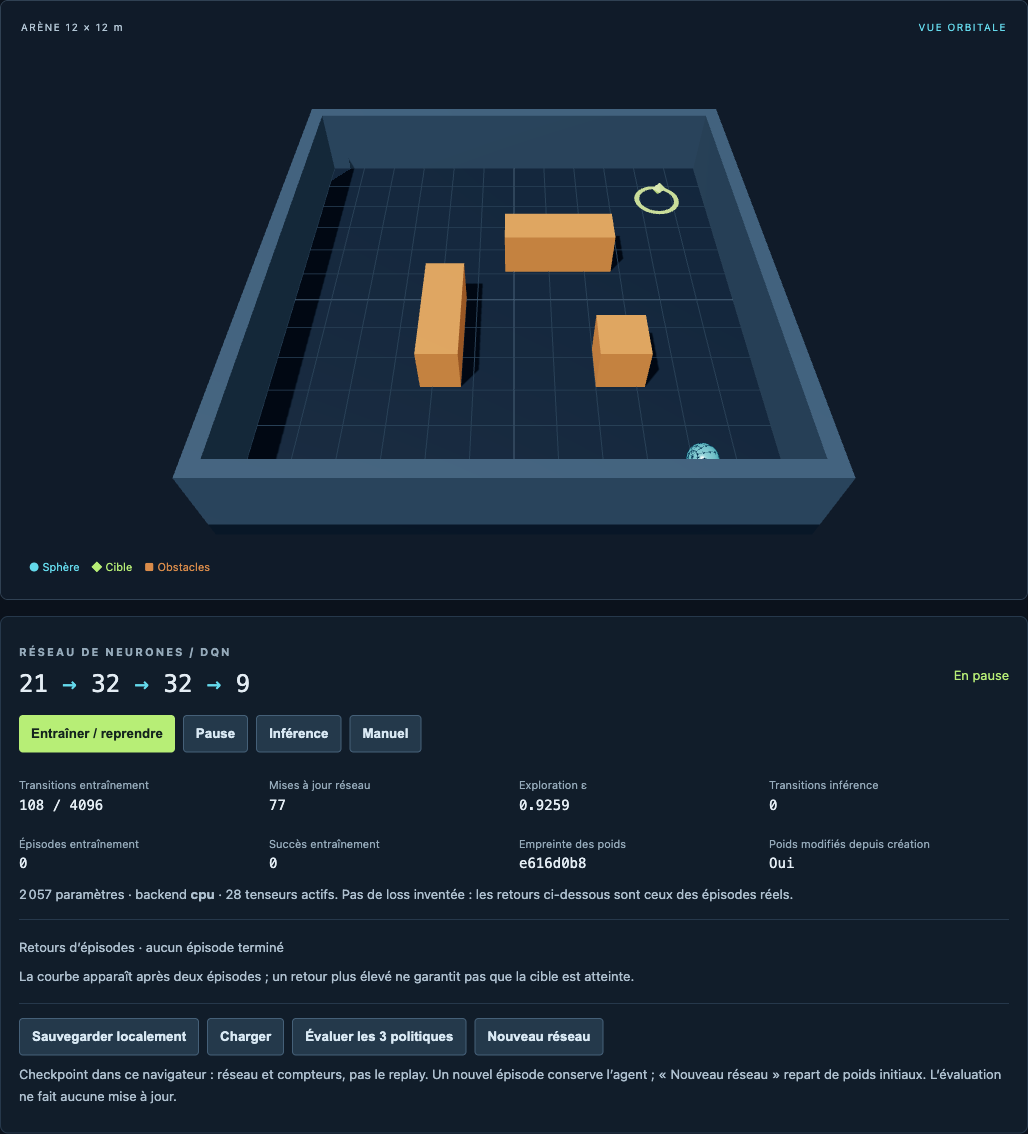
Actual short development run: 108 transitions, 77 updates and changed weights. This is neither the 4096-transition experiment nor proof of successful navigation. The demo interface is currently in French.
The world advances in fixed 1/60 s steps. Each decision applies a normalized 0.65 N·s impulse followed by six Rapier steps: one action represents 0.1 simulated seconds. Friction is 0.65 and restitution 0.55; CCD and predictive contacts limit tunneling at speed. No position clamp or hidden controller helps the agent.
BallThrustEnv owns the only physics clock. R3F copies the Rapier pose without advancing another simulation. Accelerated training changes wall-clock speed, never the solver timestep. The HUD reads the same body: position, velocity, distance and simulated time.
Start by playing
The demo opens in manual mode. Click the arena or select it with Tab:
| Control | Effect |
|---|---|
| Arrow keys, WASD or ZQSD | Horizontal impulses |
| Two combined directions | Diagonal movement, without extra thrust magnitude |
| Space, even while a direction remains held | No-op: no new impulse |
| Releasing the keys | Also a no-op, not a brake |
| Opposite direction to motion | Counter-thrust to brake |
| Drag / scroll | Orbit / zoom without changing the control axes |
Up means −z and right means +x regardless of the camera. Losing focus releases keys; keyboard input never controls the policy during training or inference. A narrow layout is not a touch controller.
The uint32 world seed, default 70, determines spawn and target positions. Réinitialiser recreates the world, settles the sphere for 120 ticks outside the episode counter, then leaves the episode paused without changing the network. Choose Manuel, Entraîner / reprendre or Inférence afterwards. Equal seeds, engine version and action sequences produce equal trajectories in tests; this is not a cross-version Rapier guarantee.
An explicit RL contract
The environment accepts nine indices: 0 no-op, 1 N, 2 NE, 3 E, 4 SE, 5 S, 6 SW, 7 W, 8 NW. Arrays and invalid indices are rejected.
Its 21 finite observations, bounded to [-1,1], contain:
- x/z position divided by 6 and x/z velocity divided by 10;
- x/z target delta divided by 12;
- height above the sphere radius divided by 2, then vertical velocity divided by 10;
- all three angular velocities divided by 25;
- eight horizontal N, NE, E, SE, S, SW, W, NW solid rays, range 4 m, normalized to
[0,1]and excluding the sphere; - x/z target position divided by 6.
Clipping only normalizes observations, never the physics state. The dense reward is 5 × (previousDistance − currentDistance) − 0.01, minus 0.001 for thrust, plus 15 for reaching the target or minus 15 for abnormal physical escape.
Success requires being within 0.7 m of the target near the floor. Success or physical failure produces terminated. The 300-action limit, 30 simulated seconds, produces truncated, never both. A manual episode ends; the runner automatically resets the world during training and inference.
The environment code that actually runs
This block is injected from packages/demo-ball-thrust/src/ball-thrust-env.ts. The scene, runner and WASM tests use that same contract. populateWorld() reuses the first slice’s physical factory; the network never receives a simplified physics substitute.
import RAPIER from '@dimforge/rapier3d-compat';
import type { TrainingEnv } from '@ignitionai/core';
import { BALL_RADIUS, GRAVITY, THRUST_INTERVAL, initialState, populateWorld, readState, thrust } from './physics';

/** Direction order shared by discrete actions and the eight horizontal sensors. */
export const ACTION_DIRECTIONS = [
  [0, 0], [0, -1], [1, -1], [1, 0], [1, 1],
  [0, 1], [-1, 1], [-1, 0], [-1, -1],
] as const;
export const ACTION_NAMES = ['no-op', 'N', 'NE', 'E', 'SE', 'S', 'SW', 'W', 'NW'] as const;
export type EpisodeOutcome = 'running' | 'success' | 'failure' | 'timeout';
export interface EpisodeSummary {
  return: number;
  steps: number;
  outcome: EpisodeOutcome;
  seed: number;
  distance: number;
}

/** Owns the simulation; Rapier.init() must be awaited by the caller first. */
export class BallThrustEnv implements TrainingEnv {
  readonly actions = ACTION_NAMES.length;
  world!: RAPIER.World;
  ball!: RAPIER.RigidBody;
  goal!: { x: number; y: number; z: number };
  seed: number;
  steps = 0;
  episodeReturn = 0;
  lastAction = 0;
  lastReward = 0;
  lastEpisode: EpisodeSummary | null = null;
  outcome: EpisodeOutcome = 'running';
  private disposed = false;

  constructor(seed = 70) {
    this.seed = seed;
    this.reset(seed);
  }

  get telemetry() { return readState(this.ball, this.goal, this.steps * THRUST_INTERVAL); }

  reset(seed = this.seed): void {
    initialState(seed); // Validate before freeing the existing world.
    if (this.world && !this.disposed) {
      if (this.steps > 0 && !this.done()) this.lastEpisode = this.summary();
      this.world.free();
    }
    this.world = new RAPIER.World(GRAVITY);
    this.disposed = false;
    const { ball, goal } = populateWorld(this.world, RAPIER, seed);
    this.ball = ball;
    this.goal = goal;
    for (let tick = 0; tick < 120; tick++) this.world.step();
    this.seed = seed;
    this.steps = 0;
    this.episodeReturn = 0;
    this.lastAction = 0;
    this.lastReward = 0;
    this.outcome = 'running';
  }

  step(action: number | number[]): void {
    if (typeof action !== 'number' || !Number.isInteger(action) || action < 0 || action >= this.actions) {
      throw new RangeError('Action must be an integer from 0 to 8 (arrays are not supported).');
    }
    if (this.disposed) throw new Error('BallThrustEnv is disposed; reset before stepping.');
    if (this.done()) return;
    const oldDistance = this.telemetry.distance;
    this.lastAction = action;
    // Do not feed an already non-finite body to the WASM solver.
    if (!this.failed()) {
      thrust(this.ball, ACTION_DIRECTIONS[action], 0);
      for (let tick = 0; tick < THRUST_INTERVAL; tick++) this.world.step();
    }
    this.steps++;
    if (this.failed()) this.outcome = 'failure';
    else if (this.telemetry.reached) this.outcome = 'success';
    else if (this.steps >= 300) this.outcome = 'timeout';
    const progress = oldDistance - this.telemetry.distance;
    this.lastReward = 5 * (Number.isFinite(progress) ? progress : 0) - 0.01 - (action === 0 ? 0 : 0.001)
      + (this.outcome === 'success' ? 15 : this.outcome === 'failure' ? -15 : 0);
    this.episodeReturn += this.lastReward;
    if (this.done()) this.lastEpisode = this.summary();
  }

  /**
   * 0..1 x,z/6; 2..3 vx,vz/10; 4..5 goal delta x,z/12;
   * 6 height above radius/2; 7 vy/10; 8..10 angular xyz/25;
   * 11..18 N,NE,E,SE,S,SW,W,NW solid rays/4; 19..20 goal x,z/6.
   * All values finite and clipped to [-1,1]; rays clipped to [0,1].
   */
  observe(): number[] {
    const { position: p, velocity: v } = this.telemetry;
    const angular = this.ball.angvel();
    const rays = ACTION_DIRECTIONS.slice(1).map(([x, z]) => {
      if (![p.x, p.y, p.z].every(Number.isFinite)) return 1;
      const length = Math.hypot(x, z);
      const ray = new RAPIER.Ray(p, { x: x / length, y: 0, z: z / length });
      const hit = this.world.castRay(ray, 4, true, undefined, undefined, undefined, this.ball);
      return Math.max(0, Math.min(1, (hit?.timeOfImpact ?? 4) / 4));
    });
    return [
      p.x / 6, p.z / 6, v.x / 10, v.z / 10,
      (this.goal.x - p.x) / 12, (this.goal.z - p.z) / 12,
      (p.y - BALL_RADIUS) / 2, v.y / 10, angular.x / 25, angular.y / 25, angular.z / 25,
      ...rays, this.goal.x / 6, this.goal.z / 6,
    ].map((value) => Number.isFinite(value) ? Math.max(-1, Math.min(1, value)) : 0);
  }

  reward(): number { return this.lastReward; }
  done(): boolean { return this.outcome !== 'running'; }
  terminated(): boolean { return this.outcome === 'success' || this.outcome === 'failure'; }
  truncated(): boolean { return this.outcome === 'timeout'; }

  dispose(): void {
    if (!this.disposed) this.world.free();
    this.disposed = true;
  }

  private failed(): boolean {
    const p = this.ball.translation();
    const v = this.ball.linvel();
    const a = this.ball.angvel();
    const q = this.ball.rotation();
    return ![p.x, p.y, p.z, v.x, v.y, v.z, a.x, a.y, a.z, q.x, q.y, q.z, q.w].every(Number.isFinite)
      || Math.abs(p.x) > 6.1 || Math.abs(p.z) > 6.1 || p.y < -1 || p.y > 3;
  }

  private summary(): EpisodeSummary {
    return { return: this.episodeReturn, steps: this.steps, outcome: this.outcome,
      seed: this.seed, distance: this.telemetry.distance };
  }
}
Train, pause and run inference
The existing DQN has 2057 parameters, with architecture 21 → 32 → 32 → 9. It uses TF.js CPU, Adam at 0.001, batches of 32, a replay of 8192 transitions, γ = 0.99 and a target update every 100 updates. Its network seed is 68. Exploration starts at 1 and decays towards 0.05.
IgnitionEnvTFJS.step() provides training transitions; inferStep() selects greedy actions without replay insertion or fit. The demo does not reimplement replay or Bellman targets.
In the browser, Entraîner / reprendre changes the network. Pause also waits for an already running fit. Inférence uses exactly that network without changing weights. The panel exposes update counters, epsilon and a weight fingerprint; the chart shows episode returns, not a fabricated loss.
To reproduce those operations inside the package:
import RAPIER from '@dimforge/rapier3d-compat';
import * as tf from '@tensorflow/tfjs';
import { BallThrustEnv } from './src/ball-thrust-env';
import { TrainingSession } from './src/training-session';

await RAPIER.init();
await tf.setBackend('cpu');
await tf.ready();
const session = new TrainingSession(new BallThrustEnv(70));
await session.runSteps(4096, 'training');
await session.save();
const evaluation = await session.evaluate();
await session.start('inference');
// On teardown: await session.dispose();
Sauvegarder localement writes the model to IndexedDB with version, configuration, epsilon and counters. Charger retrieves the weights after a page reload. Metadata and actual tensors are validated before replacing the active agent. Quota, missing-checkpoint and incompatibility errors remain visible.
This is not a bit-for-bit training-process resume: replay, optimizer state and random-generator position are not restored. Replay must warm up again. Nouveau réseau explicitly restarts from initial weights.
Measure instead of promising convergence
The versioned protocol was fixed before execution: environment seed 70, network seed 68, a ceiling of 4096 transitions and five minutes. Pausing or creating a new episode does not refund a network’s spent budget.
Évaluer les 3 politiques compares the initial network, the current greedy network and a uniform random baseline seeded 2026 on the same held-out seeds 1000 through 1007, at most 300 actions per episode. Evaluation uses separate worlds, leaves the visible arena unchanged and performs no training. Expandable raw results give return, success, duration and final distance per seed. A higher return with zero targets reached is still a navigation failure, not a success to relabel.
Real tests verify collisions and resets, the bounded contract, episode endings, changed training weights, exact inference equality, checkpoint reload and tensor-count plateaus. Browser harnesses drive actual buttons and read IndexedDB artifacts. Dated, SHA-linked evidence lives in evidence/; RAF cadence and p95 are not GPU timings or mobile performance promises.
pnpm install --frozen-lockfile
pnpm --filter demo-ball-thrust dev --host 127.0.0.1 --port 5173
pnpm --filter demo-ball-thrust test
pnpm --filter demo-ball-thrust typecheck
pnpm test
Open localhost:5173, or use the embedded demo directly. No token, remote service or pretrained model is required.