
· Tutorial
Robot Arm 3D: reaching an XYZ target with DQN
An ideal 3-joint arm, 325 configurations and 6 actions: follow how a dense reward brings the tip closer to the target, with real measurements and their limits.
The arm moves in three dimensions, but the agent only sees six numbers. Robot Arm 3D isolates one spatial skill: bringing the tip of an ideal kinematic arm closer to an XYZ target — no gravity, no inertia, no inverse kinematics.
Three joints on a 15° grid — base, shoulder, elbow — give 325 configurations and a tip living in a shell-shaped reachable volume. The 3D is not decorative: targets vary in height, depth and lateral position, and each action moves exactly one joint.
You will train a real DQN in the browser, then freeze its network for inference.
Try Robot Arm 3D in your browser →
Start with the demo
Click Train. The network is created, weights move at every update, epsilon decays. Switch to Inference: the weights are frozen, only the greedy policy runs. New episode draws a new target while keeping the network; Restart learning destroys and recreates the network.
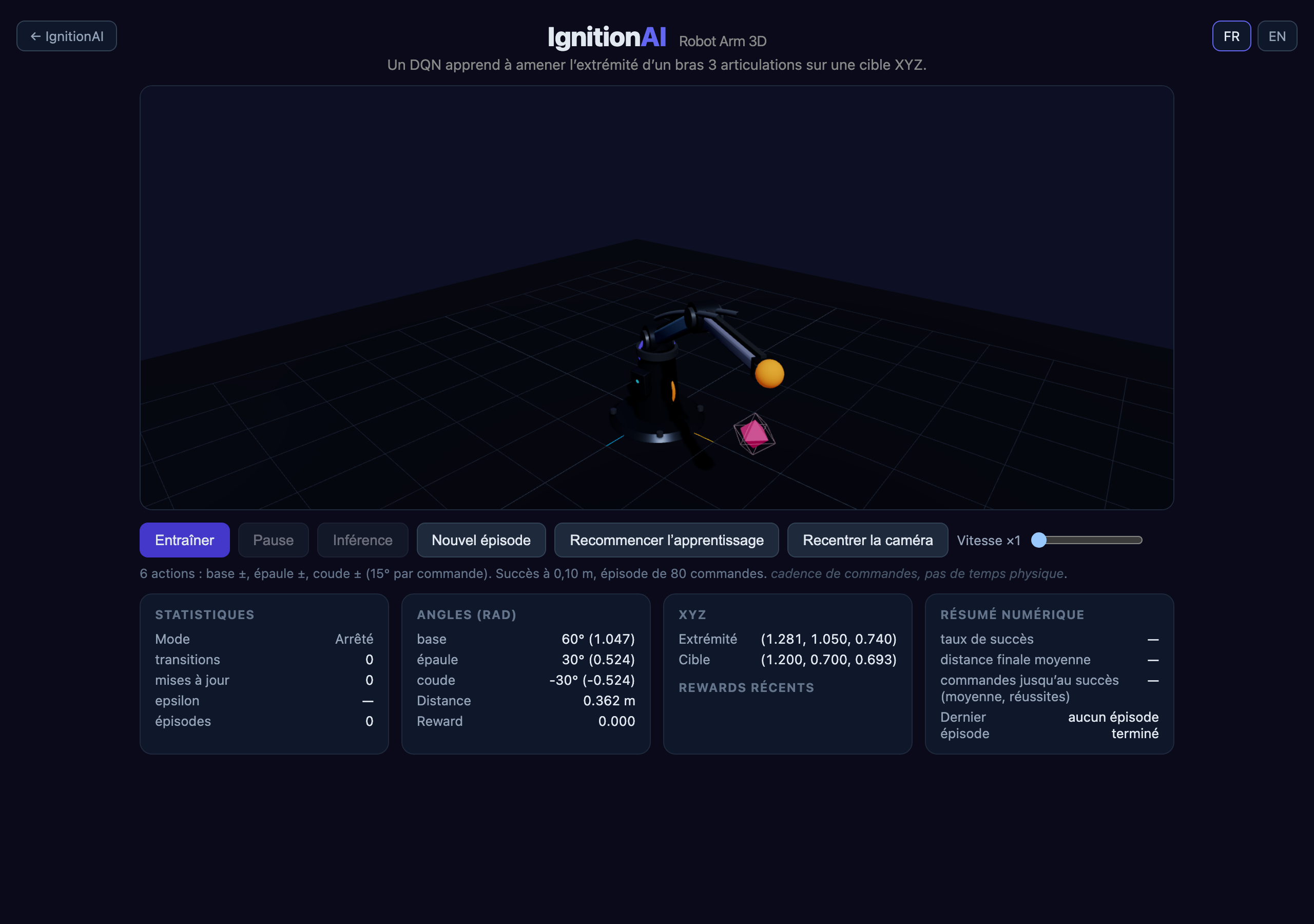
Initial state captured in headless Chromium. Screenshots show the journey, not a converged policy.
What the agent receives
The robot-arm-v1 contract places the pivot at (0, 0.6, 0) with L1 = 0.9 m and L2 = 0.7 m. Forward kinematics is exact: r = L1·cos(q1) + L2·cos(q1+q2), x = r·sin(q0), y = 0.6 + L1·sin(q1) + L2·sin(q1+q2), z = r·cos(q0).
Six observations bounded in [-1, 1]: the three normalized joint angles, then (target - tip)/3.2 on x, y and z. The target's generating configuration is not exposed — the agent must learn the geometry, not memorise it.
Six actions: base ±, shoulder ±, elbow ±, one 15° step per command. At a grid limit the command is a no-op counted as blocked. An episode lasts 80 commands; success requires bringing the tip within 0.10 m of the target — which, on this grid, means reaching its exact configuration or one of the rare neighbouring ones (the closest distinct pair on the grid sits at ~0.075 m).
What the reward encourages
Each command receives 2(d-d')/1.6 - 0.02d'/1.6 - 0.01 - 0.02·blocked + success, where d and d' are the distances before/after. Approaching pays, retreating costs, blocked commands cost a little more, and success adds +1. This dense reward guides the agent at every command — unlike sparse-reward tasks.
The network is a standard DQN: 6 inputs, two hidden layers of 64 ReLU neurons, 6 outputs. Learning rate 0.001, gamma 0.99, batch 32 over a 10,000-entry replay, epsilon from 1.0 to 0.05 decaying by 0.9995 per update, target network resynced every 500 updates.
Method and real measurements
Protocol frozen before execution (robot-arm-v1-protocol-1): 80 unique targets drawn without replacement from the grid (48 train / 12 validation / 20 test), declared evaluation starts identical for every policy, three seeds 11/29/47 with separate environment/agent random streams. Budget: 5,000 transitions or 3 minutes per seed, whichever hits first — all three seeds were stopped by the transition budget.
Training and inference use the same controller and preset as the browser demo; the measurement backend is the native TensorFlow backend (tensorflow, tfjs 4.22.0, macOS arm64). Weight variation during training: confirmed (Δ|w| ≈ 419–480, 4,969 updates, epsilon 1.0 → 0.083 on every seed).
| Seed | Initial network | Final network (greedy) |
|---|---|---|
| 11 | 1/20 success, mean d 1.441 m | 5/20 success, mean d 0.466 m |
| 29 | 0/20 success, mean d 1.805 m | 5/20 success, mean d 0.470 m |
| 47 | 1/20 success, mean d 1.714 m | 11/20 success, mean d 0.283 m |
Seeded uniform random policy (same episodes, same starts): 4/20 success, mean final distance 1.187 m. On successes, the final network reaches the target in ~6–7 commands on average versus ~54 for the random policy. The 12 validation episodes (observed only, no selection) point the same way: 6/12, 9/12 and 7/12 successes.
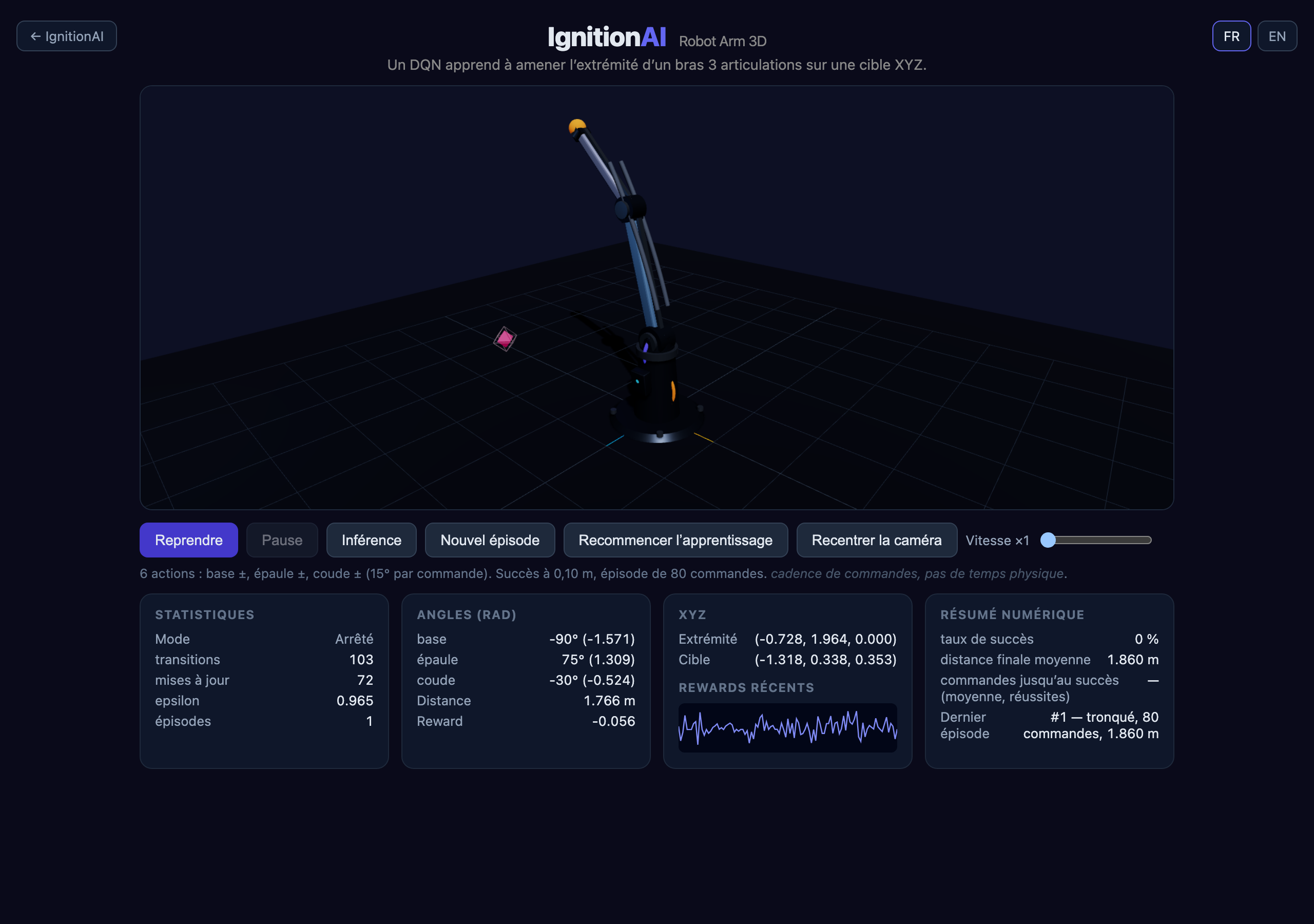
Real training launched before the capture: transitions, updates and epsilon come from the controller, not a simulation.
What to take away (and what not to conclude)
All three seeds cut the mean distance by a factor of 3 to 6 and beat the random baseline. But seed-to-seed variation (5/20 versus 11/20) is real, the 5,000-transition budget is short, and nothing here proves convergence: with ~15 minutes of cumulative training, the DQN learned a clearly better-than-chance policy on a discrete spatial task — that is the honest limit of the result.
Inference verifies the expected invariance: weights and counters strictly frozen during greedy steps, as in the demo.
Reproduce the experiment with code
Use Node.js 20+ and pnpm 10.8.0. From the repository:
git clone https://github.com/IgnitionAI/ignition.git
cd ignition
corepack enable
pnpm install --frozen-lockfile
pnpm --filter demo-robot-arm dev
Open localhost:3011. The example is loaded directly from blog-experiment.ts: the article's code and the repository's code stay in sync.
import { RobotArmController } from '../controller';

/**
 * Independent experiment for the blog article — the same controller and DQN
 * preset as the demo UI. Import it in the browser console while `pnpm dev` runs:
 *
 *   const { createExperiment } = await import('/examples/blog-experiment.ts');
 *   const session = createExperiment();
 *   session.train();       // creates the DQN agent, starts training
 *   session.pause();       // stops scheduling, waits for the current transition
 *   session.infer();       // greedy steps with the frozen network
 *   session.stop();        // alias of pause()
 */
export function createExperiment() {
  const controller = new RobotArmController(29);
  return {
    controller,
    snapshot: () => controller.snapshot(),
    train: () => controller.train(),
    infer: () => controller.infer(),
    pause: () => controller.pause(),
    stop: () => controller.pause(),
    newEpisode: () => controller.newEpisode(),
    dispose: () => controller.dispose(),
  };
}
While Vite runs, import the module in the browser console:
const { createExperiment } = await import('/examples/blog-experiment.ts');
const session = createExperiment();
await session.train();   // creates the DQN, starts training
session.pause();         // waits for the current transition, then stops
session.infer();         // greedy policy, frozen weights
session.stop();
To replay the full measurement protocol (3 seeds, frozen evaluation, baseline): pnpm --filter demo-robot-arm measure. Raw per-seed data is kept in packages/demo-robot-arm/evidence/.
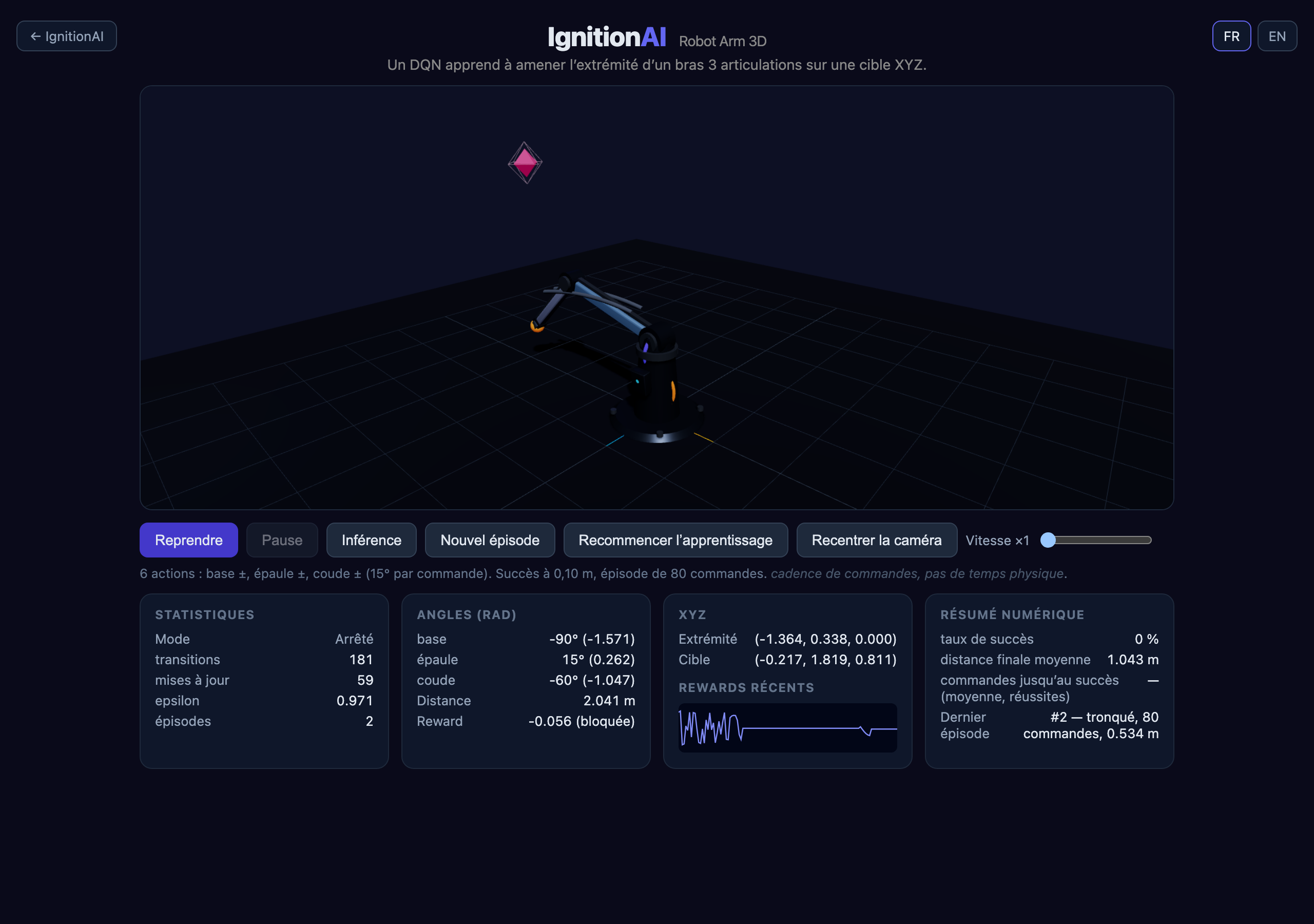
Inference launched after training, in the same session. Mode and counters come from the real controller.
Your turn
Reproduce the journey, then change exactly one contract element — the reward, the angle grid, the budget — and compare. You will have a concrete case for discussing what the agent knows, what it chooses, and what the reward actually values.
To go further, read the Ignition runner and the available algorithms.