
· Tutorial
CartPole 3D: reading the observations
From raw state vector to agent decision in the 3D scene.
The camera orbits around the cart. The pole glints, shadows shift. The agent, meanwhile, keeps receiving four numbers. CartPole 3D shows how to separate a spectacular scene from the learned problem.
Rendering helps you understand the motion, but it does not necessarily define the network's observations. This separation lets you work on the interface without silently changing the learning task.
You will run the experiment and understand the link between its observations, its decisions, and its outcome.
Try CartPole 3D in the browser →
Start with the demo
Keep DQN selected and click Train. Watch the pole in the scene, then switch to Inference. Changing the camera is not a new learning run; to change the task, you must modify what the environment provides or computes.
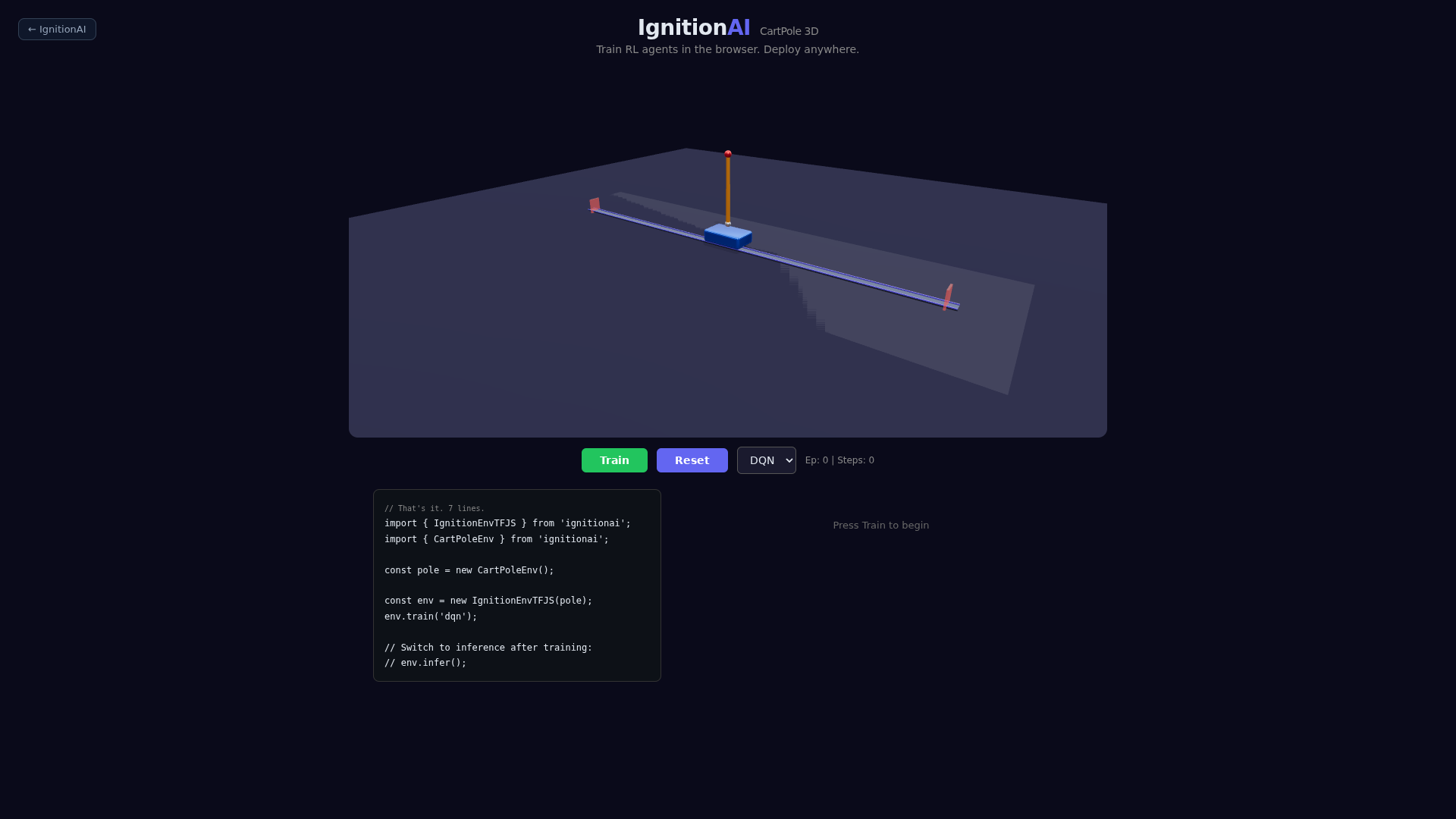
Initial state captured in Chromium. Screenshots show the walkthrough, they do not guarantee a score.
What the agent receives
The demo imports CartPoleEnv from the environments package. The network receives the cart's position, its velocity, the pole's angle, and its angular velocity. It chooses between a push to the left and a push to the right. The camera does not enter this observation.
What the reward encourages
As in the 2D version, the angle limit is 12 degrees, the position limit is 2.4 meters, and the horizon is 500 transitions. A non-terminal transition is worth +1; the last one is worth 0. The chart counts balanced transitions, including the last one.
The full contract lives in App.tsx. Read observe(), step(), and reward() together: a benchmark's name is not enough to define its implementation.
Reproduce the experiment with code
Use Node.js 20 or 22 and pnpm 10.8.0. From the repository:
git clone https://github.com/IgnitionAI/ignition.git
cd ignition
corepack enable
pnpm install --frozen-lockfile
pnpm --filter demo-cartpole-3d dev --host 127.0.0.1 --port 5173
Open localhost:5173. On a VPS, use an SSH tunnel to that port to access it from your computer.
The example is loaded directly from blog-experiment.ts: the article's code and the repository's code stay in sync.
import { IgnitionEnvTFJS } from '@ignitionai/backend-tfjs';
import { CartPoleEnv } from '@ignitionai/environments';

export function createExperiment() {
  const environment = new CartPoleEnv();
  const runner = new IgnitionEnvTFJS(environment);
  runner.train('dqn');

  return {
    environment,
    runner,
    infer: () => runner.infer(),
    resume: () => runner.train('dqn'),
    stop: () => runner.stop(),
  };
}
While Vite is running, you can import this module in the browser console:
const { createExperiment } = await import('/examples/blog-experiment.ts');
const session = createExperiment();
// Après quelques tentatives :
session.infer();
session.stop();
The module creates an independent session. It does not wire it into the already-open scene: use the demo's buttons for the visual walkthrough. infer() applies the current policy without training; resume() keeps the agent and stop() cancels upcoming ticks. A transition already in progress can still finish.
Observe, then evaluate
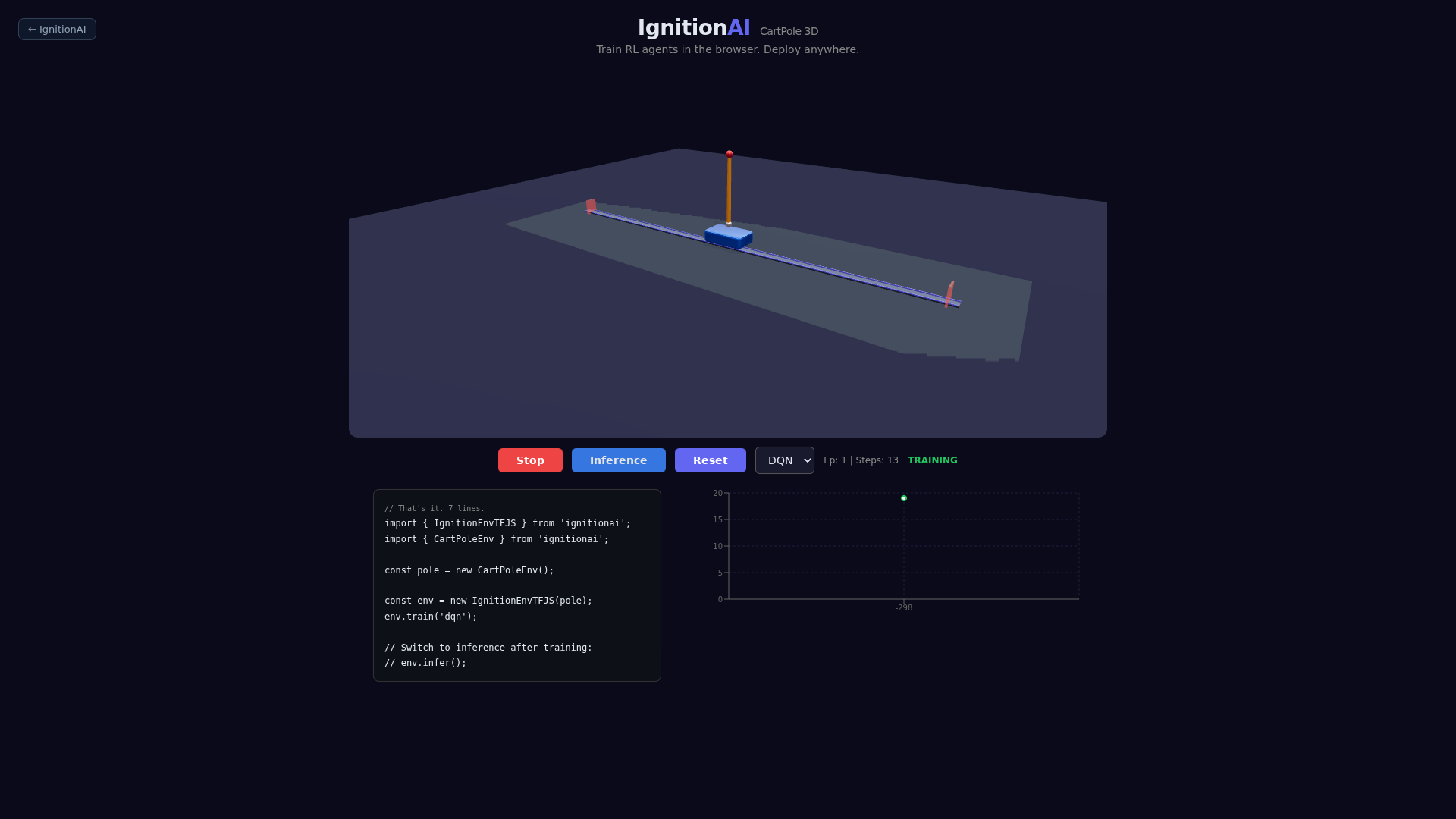
Screenshot of the same session after interaction. The presence of a scene and an active indicator confirms the walkthrough, not a converged policy.
Compare the 2D and 3D versions with identical parameters and protocol. Measure episodes, not frame smoothness: rendering cost and compute time can vary. A 3D representation does not prove a better policy.
Verification of this edition
The demo was opened in Chromium and its training launched before the screenshot. The independent example ran one training transition and one inference transition with 4 observations, then the mode-switch commands. No page or runner errors were reported during this verification. This walkthrough verifies integration; it does not prove convergence.
Your turn to run the experiment
Reproduce the walkthrough, then change a single element of the contract and compare your observations. You will have a concrete case to discuss what the agent knows, what it chooses, and what the reward values.
To go further, see the Ignition runner and the available algorithms.