
· Tutorial
Maze: sensors and rewards
Dense rewards and sensors guiding the agent out of the maze.
The path looks clear, then a moving danger cuts it off. A door changes the possible passage. In Maze, the useful decision depends on what the agent perceives right now.
The maze connects a sensor to a behavior: going around a wall, opening a door, or avoiding a dangerous area. The reward guides exploration, but it can also favor an unexpected trade-off.
You will run the experiment and understand the link between its observations, its decisions, and its outcome.
Start with the demo
Pick an algorithm and click Train. Follow the rays, the door, and the collisions, then use Inference. The scene displays a 3D arena, while MazeEnv handles the logical movements and collisions in the plane.
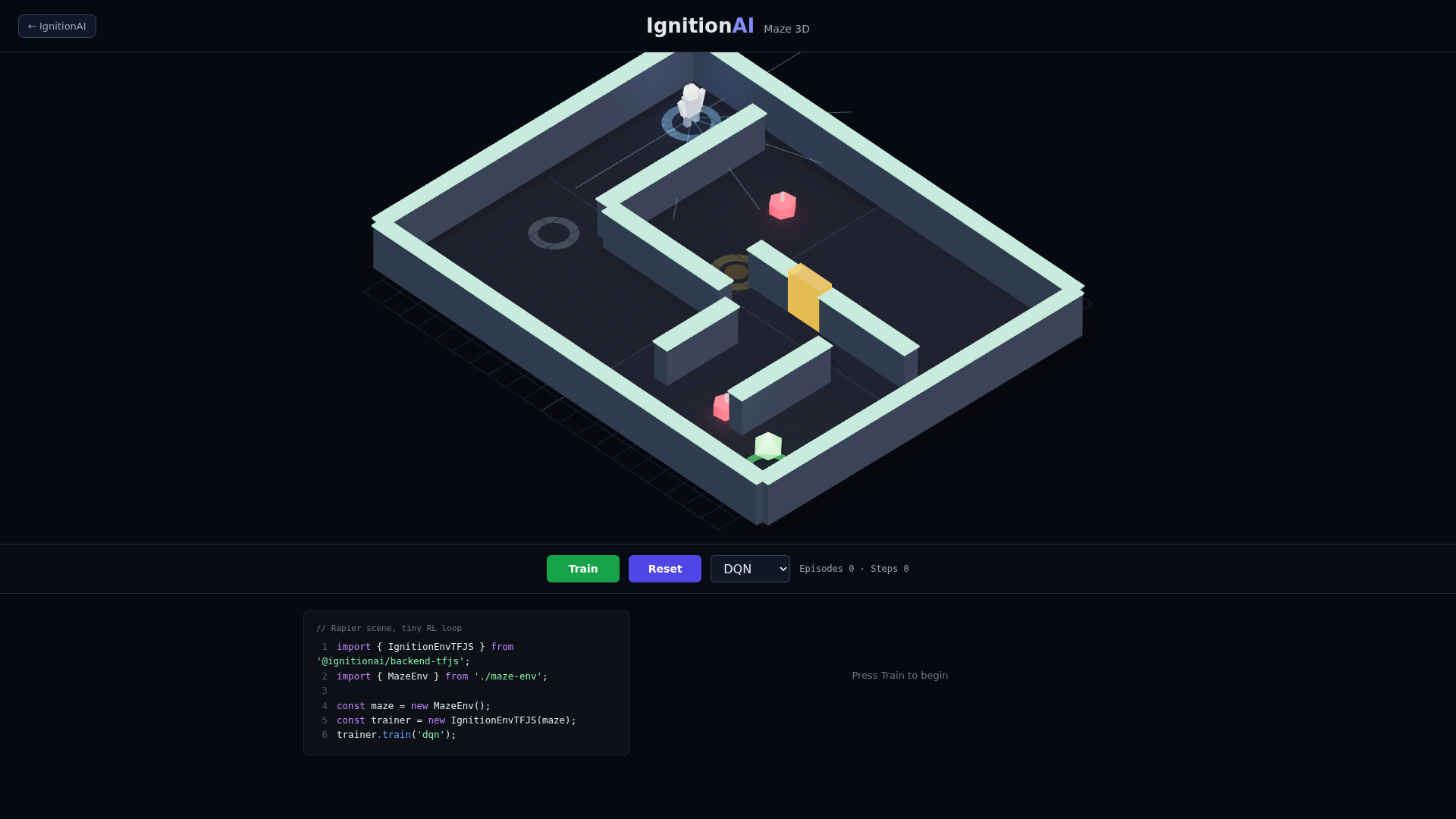
Initial state captured in Chromium. The screenshots show the journey, not a guaranteed score.
What the agent receives
MazeEnv provides 16 values: normalized position, orientation as sine/cosine, goal information, six sensors, danger proximity, door state, and recent progress. Its six actions are move forward, turn left/right, strafe left/right, or wait.
What the reward encourages
The goal gives a base reward of 1.4. Otherwise, the base combines −0.012 and progress toward the goal multiplied by 0.15. A blocked action removes 0.09, a touched danger 0.18, and waiting 0.025. A discovered checkpoint adds 0.08. The episode ends at the goal or after 260 transitions.
The full contract lives in maze-env.ts. Read observe(), step(), and reward() together: a benchmark's name is not enough to define its implementation.
Reproducing the experiment with code
Use Node.js 20 or 22 and pnpm 10.8.0. From the repository:
git clone https://github.com/IgnitionAI/ignition.git
cd ignition
corepack enable
pnpm install --frozen-lockfile
pnpm --filter demo-maze dev --host 127.0.0.1 --port 5173
Open localhost:5173. On a VPS, use an SSH tunnel to that port to access it from your computer.
The example is loaded directly from blog-experiment.ts: the article's code and the repository's code stay in sync.
import { IgnitionEnvTFJS } from '@ignitionai/backend-tfjs';
import { MazeEnv } from '../maze-env';

export function createExperiment() {
  const environment = new MazeEnv();
  const runner = new IgnitionEnvTFJS(environment);
  runner.train('dqn');

  return {
    environment,
    runner,
    infer: () => runner.infer(),
    resume: () => runner.train('dqn'),
    stop: () => runner.stop(),
  };
}
While Vite is running, you can import this module in the browser console:
const { createExperiment } = await import('/examples/blog-experiment.ts');
const session = createExperiment();
// After a few attempts:
session.infer();
session.stop();
The module creates an independent session. It does not attach it to the already-open scene: use the demo's buttons for the visual journey. infer() applies the current policy without training; resume() keeps the agent, and stop() cancels the upcoming ticks. A transition already in progress can still finish.
Observe, then evaluate
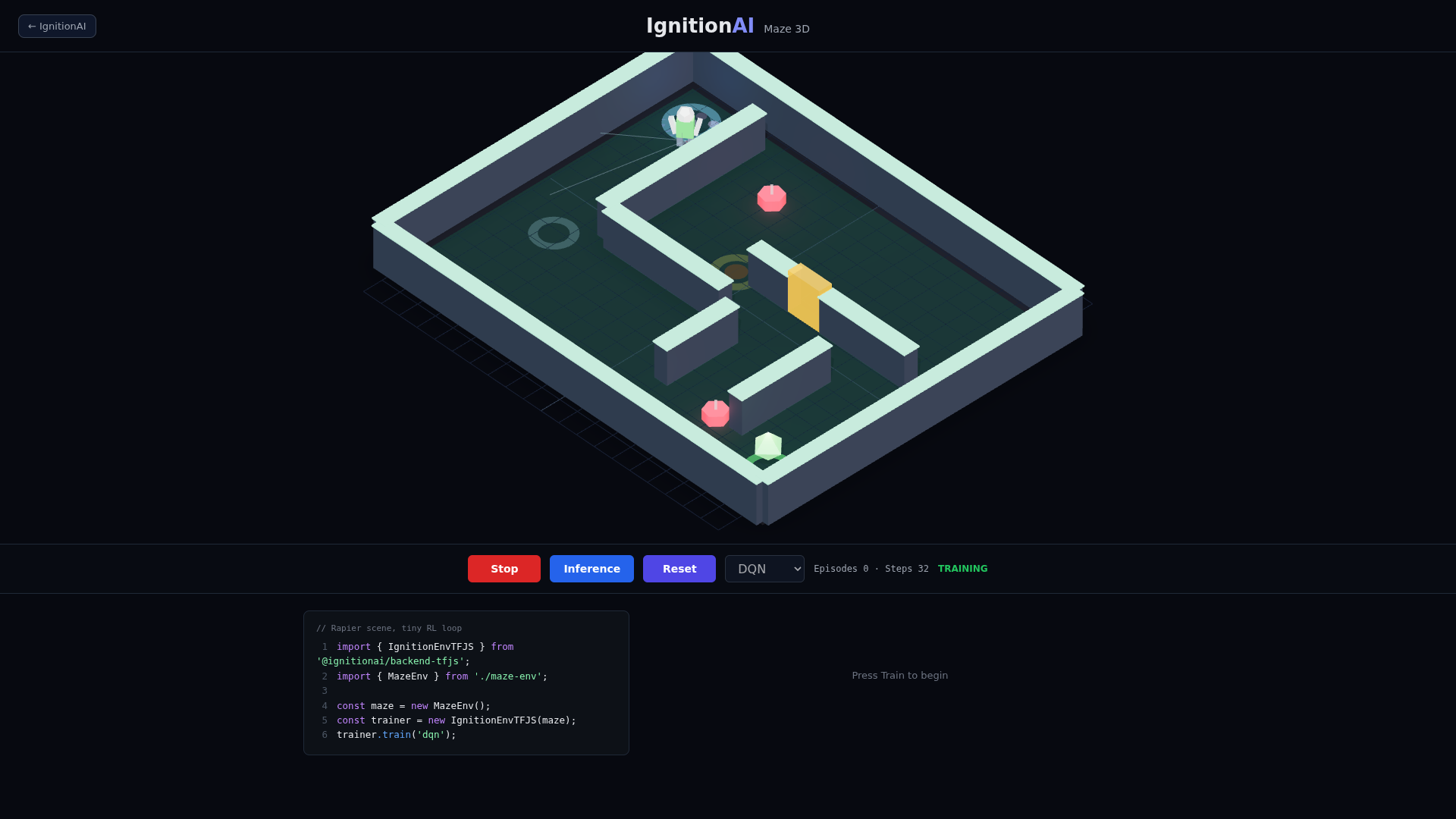
Screenshot of the same session after interaction. The presence of a scene and an active indicator confirms the journey, not a converged policy.
The six sensors do not describe the entire future of moving dangers. A good average reward is therefore not enough: also record arrivals, collisions, and blockages. Then try removing an observation to understand its role, without mixing the results of the two contracts.
Verifying this edition
The demo was opened in Chromium and its training launched before the screenshot. The standalone example ran one training transition and one inference transition with 16 observations, then the mode-switching commands. No page or runner error was recorded during this verification. This journey verifies the integration; it does not prove convergence.
Your turn to run the experiment
Reproduce the journey, then change a single element of the contract and compare your observations. You will have a concrete case to discuss what the agent knows, what it chooses, and what the reward values.
To go further, see the Ignition runner and the available algorithms.