
· Tutorial
Circuit racing: training a driver
Teaching an agent to follow a track with dense rewards.
Brake before the corner, pick your line, and avoid the other cars: Circuit Racing gives you a visible playground for understanding the difference between driving, learning, and measuring.
A driver can imitate a reference controller or learn from rewards. The final race must then use a frozen policy. Separating these steps prevents you from mistaking training progress for racing performance.
You will run the experiment and understand the link between its observations, its decisions, and its outcome.
Try Circuit Racing in the browser →
Start with the demo
Open the garage, pick a car, and Take the wheel to discover the track with the keyboard. Then move on to Train: the page distinguishes training, testing, saving, and racing. The example below produces a DQN checkpoint after a small budget of transitions.
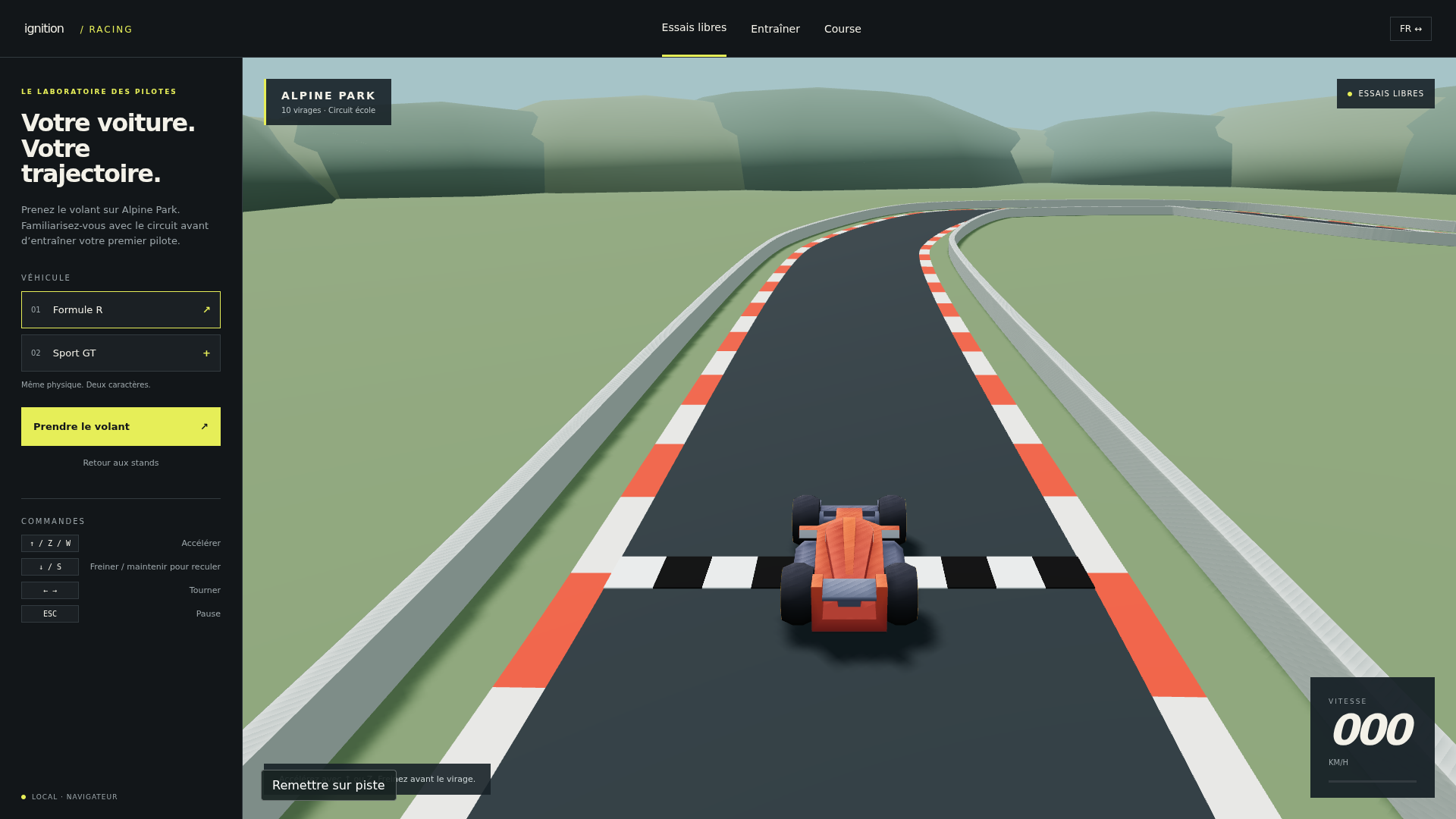
Initial state captured in Chromium. Screenshots show the walkthrough, they do not guarantee a score.
What the agent receives
The racing-observation-v1 contract contains 20 values: speed, heading, lateral offset, heading error, four line cues, and three sets of four values for nearby opponents. The network chooses among nine actions. For DQN and Double DQN, a decision is held for six physics ticks.
What the reward encourages
Q-learning rewards progress on the track and gates crossed, then subtracts penalties, a per-decision cost, and off-track exits. MLP imitation, by contrast, learns from labels provided by the reference controller: its loss is not a racing reward. Any comparison must name the mechanism used.
The full contract lives in racing/q-training.ts. Read observe(), step(), and reward() together: a benchmark's name is not enough to define its implementation.
Reproduce the experiment with code
Use Node.js 20 or 22 and pnpm 10.8.0. From the repository:
git clone https://github.com/IgnitionAI/ignition.git
cd ignition
corepack enable
pnpm install --frozen-lockfile
pnpm --filter demo-car-circuit dev --host 127.0.0.1 --port 5173
Open localhost:5173. On a VPS, use an SSH tunnel to that port to access it from your computer.
The example is loaded directly from blog-experiment.ts: the article's code and the repository's code stay in sync.
import * as tf from '@tensorflow/tfjs';
import { LearnedDriver } from '../racing/learned-driver';
import { trainQDriver } from '../racing/q-training';

export async function trainSmallExperiment(transitions = 64) {
  await tf.setBackend('cpu');
  await tf.ready();
  const driver = new LearnedDriver(11, 'dqn');
  const initial = driver.exportCheckpoint();
  driver.dispose();

  // A smoke run, not the full evaluation protocol.
  return trainQDriver(initial, { transitions });
}
While Vite is running, you can import this module in the browser console:
const { trainSmallExperiment } = await import('/examples/blog-experiment.ts');
const checkpoint = await trainSmallExperiment();
checkpoint.algorithm; // dqn
The checkpoint is a result of this small training run; load it into a LearnedDriver to apply the policy. This module uses the CPU backend required by trainQDriver().
Observe, then evaluate
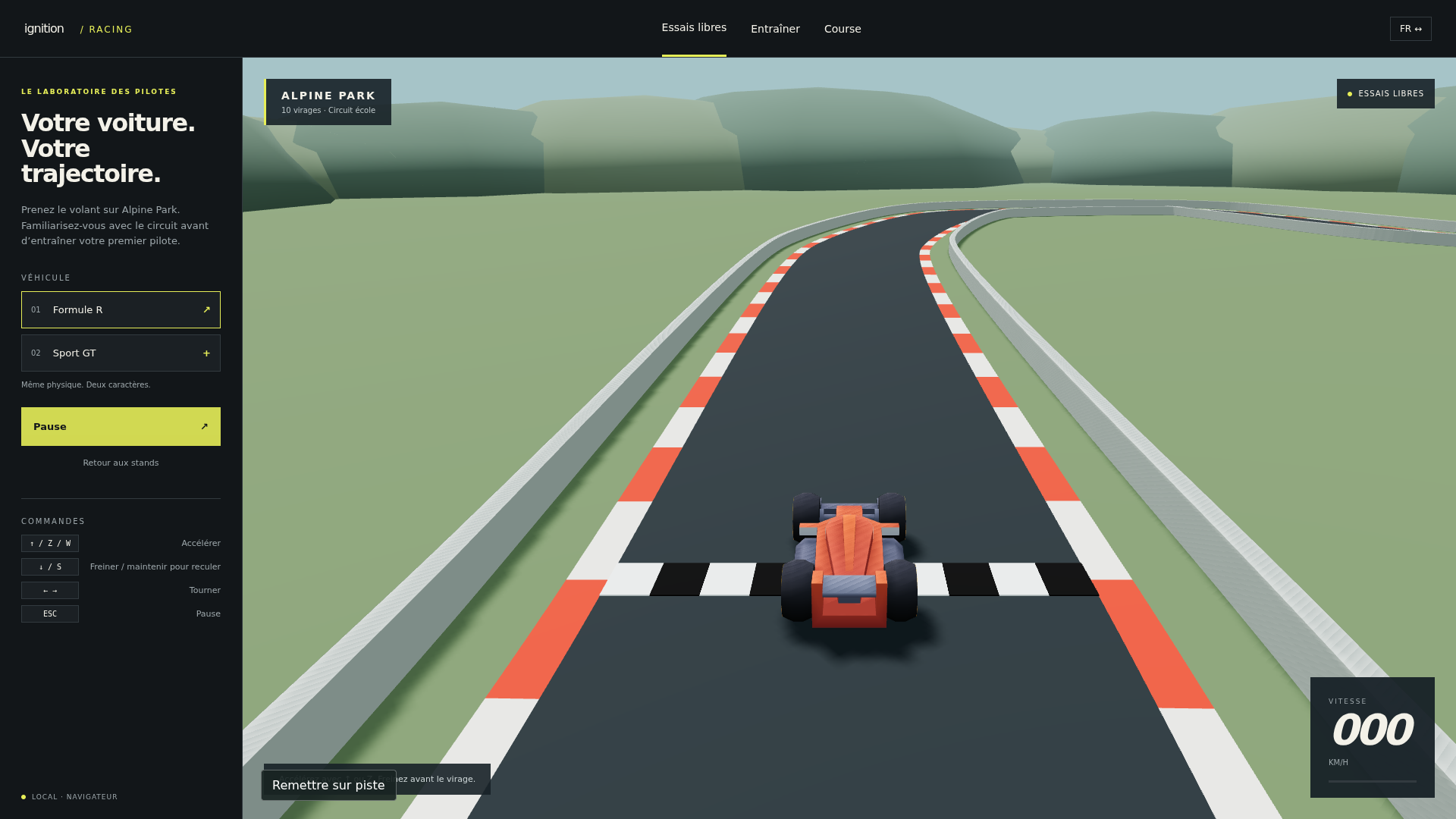
Screenshot of the same session after interaction. The presence of a scene and an active indicator confirms the walkthrough, not a converged policy.
The declared Q protocol uses 20,000 transitions and an evaluation across multiple seeds, two tracks, and solo/traffic modes. Our 64-transition example is an execution check, not that full protocol. During an evaluation, keep failures, off-track exits, and penalties as well; do not only select the prettiest race.
Verification of this edition
The demo was opened in Chromium and free runs were enabled. The CPU example produced a dqn checkpoint after 64 transitions, with 9 updates and 6 weight tensors. No complete race result is claimed.
Your turn to run the experiment
Reproduce the walkthrough, then change a single element of the contract and compare your observations. You will have a concrete case to discuss what the agent knows, what it chooses, and what the reward values.
To go further, see the Ignition runner and the available algorithms.